
How Is AI Changing Financial Forecasting?
Financial forecasting has traditionally relied on historical financial statements, spreadsheets, assumptions, and the experience of finance professionals. Today, AI in financial forecasting is changing how businesses analyse data, predict future performance, and make smarter financial decisions.
While these methods remain useful, businesses now have access to technologies that can analyse much larger amounts of data and identify patterns much faster.
AI in financial forecasting is changing how businesses predict revenue, expenses, cash flow and future financial performance. Instead of relying solely on historical trends and manually updated spreadsheets, businesses can use artificial intelligence and machine learning to analyse data, identify patterns, detect anomalies and generate more dynamic forecasts.
For growing businesses, this can mean faster financial analysis, better visibility and more informed decision-making.
But AI does not eliminate the need for financial expertise. The most effective approach combines AI-powered analytics with accurate data, sound financial models and human judgement.
What Is AI Financial Forecasting?
AI financial forecasting uses artificial intelligence and machine learning to analyse financial and business data and generate predictions about future performance.
AI is increasingly being used across the financial sector to analyse large datasets, automate processes and support financial decision-making. The International Monetary Fund’s research on artificial intelligence and finance provides useful context on the growing role of AI in finance.
Traditional forecasting might involve a finance professional reviewing previous revenue and expenses and manually creating projections.
An AI-powered system can analyse much larger datasets and consider multiple variables simultaneously.
Depending on the system and available data, these variables could include:
- Historical revenue
- Expenses
- Cash flow
- Customer behaviour
- Sales trends
- Seasonal patterns
- Inventory
- Market conditions
- Operational performance
- Pricing
- Customer demand
The result is a more dynamic approach to forecasting.
Instead of simply asking:
“What happened last year?”
business leaders can begin asking:
“Based on our current data, what is likely to happen next?”
How Is AI Changing Financial Forecasting?
AI is changing financial forecasting in several important ways.
1. AI Can Analyse More Data
Traditional forecasting can become difficult when financial information is spread across spreadsheets, accounting systems, CRM platforms, ERP systems and other applications.
AI-powered analytics can process information from multiple sources when those systems are properly connected.
This allows businesses to analyse financial and operational data together.
For example, revenue may be affected by:
- Customer acquisition
- Product demand
- Pricing
- Inventory
- Marketing activity
- Seasonality
Looking at these variables together can provide a more complete picture than analysing revenue alone.
2. AI Can Identify Patterns Humans May Miss
One of the strengths of machine learning is its ability to identify patterns in large datasets.
For example, an AI system may identify relationships between:
- Seasonal sales fluctuations
- Customer purchasing behaviour
- Marketing activity
- Operating expenses
- Inventory levels
These patterns can then contribute to future forecasts.
This does not mean AI will always predict the future correctly. Instead, it provides another layer of analysis that can help financial teams make better-informed decisions.
3. Forecasts Can Be Updated More Frequently
Traditional financial forecasts are often created periodically and manually updated.
This can mean that a forecast becomes outdated when business conditions change.
AI-powered forecasting can work with more frequently updated data.
If new sales, expense or operational data enters the system, the forecast can potentially be adjusted to reflect the latest information.
This is particularly useful for businesses operating in environments where conditions change quickly.
AI Can Improve Cash Flow Forecasting
Cash flow forecasting is one of the areas where AI can provide significant value.
A business needs to know not only how profitable it may be in the future but also whether it will have enough cash available to meet its obligations.
AI can analyse historical cash flow and other business data to help identify potential patterns in:
- Customer payments
- Sales
- Expenses
- Supplier payments
- Seasonal demand
- Working capital
This can help businesses identify potential cash shortages earlier.
For example, if a business is likely to experience a cash-flow gap several weeks from now, management may have more time to adjust spending, accelerate collections or review financing options.
Tahari Solutions specifically provides cash-flow forecasting and working-capital management through its Fractional CFO services.

AI Makes Scenario Planning More Powerful
One of the biggest advantages of modern forecasting is the ability to model different scenarios.
Instead of creating one forecast, businesses can examine several possibilities.
Scenario 1: Revenue increases
What happens if sales increase by 10%?
Scenario 2: Revenue decreases
What happens if sales decline by 10%?
Scenario 3: Expenses increase
What happens if operating costs rise?
Scenario 4: New investment
What happens if the business hires more employees, opens another location or purchases new equipment?
AI-powered analytics can help businesses model these scenarios more efficiently.
This gives management a better understanding of potential risks and opportunities before making major decisions.
AI Can Help Detect Financial Anomalies
Another important application of AI is anomaly detection.
An AI-powered financial system can analyse normal patterns and identify unusual activity.
For example, it might flag:
- An unexpected increase in expenses
- Unusual revenue fluctuations
- A sudden change in customer payments
- Abnormal purchasing patterns
- Unexpected changes in margins
A flagged anomaly does not automatically mean something is wrong.
It simply tells the finance team:
“This deserves a closer look.”
That can help businesses investigate potential problems earlier.
AI Can Reduce Manual Financial Analysis
Finance teams can spend significant amounts of time collecting data, cleaning spreadsheets, preparing reports and updating forecasts.
Automation can reduce some of this repetitive work.
For example, an AI-enabled financial analytics system can help automate:
- Data processing
- Trend identification
- Report generation
- Forecast updates
- Anomaly detection
- Performance analysis
This allows finance professionals to spend more time interpreting results and advising management.
The goal is not to replace financial professionals.
The goal is to give them better tools.
AI and Real-Time Financial Dashboards
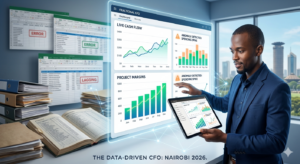
AI becomes even more useful when combined with real-time dashboards.
A dashboard can bring important financial information into one place, including:
- Revenue
- Expenses
- Cash flow
- Profitability
- Accounts receivable
- Accounts payable
- Budgets
- Forecasts
- Key performance indicators
Tahari Solutions develops Executive, Operational, Financial and Supply Chain dashboards, with automated logic and triggers designed to centralise important business metrics.
When AI-powered analytics are added to this environment, businesses can move beyond simply viewing charts.
The system can help identify what changed, where the change occurred and what patterns may require attention.
Traditional Forecasting vs AI-Powered Forecasting
| Traditional Forecasting | AI-Powered Forecasting |
|---|---|
| Often relies heavily on historical data | Can analyse historical and current data |
| Manual spreadsheet updates | Greater automation |
| Periodic forecasting | More frequent forecast updates |
| Limited number of variables | Can analyse many variables |
| Manual pattern identification | Machine learning can identify patterns |
| Scenario modelling can be time-consuming | Scenarios can be modelled more efficiently |
| Strongly dependent on analyst time | Supports analysts with automated analysis |
AI does not make traditional forecasting obsolete.
Instead, it can enhance existing financial forecasting processes.
What Are the Benefits of AI in Financial Forecasting?
Businesses implementing AI-powered financial forecasting can potentially benefit from:
Better Decision-Making
Management receives more information to support financial decisions.
Faster Analysis
Large amounts of data can be analysed more quickly than through entirely manual processes.
Improved Visibility
Businesses can gain a clearer picture of current financial and operational performance.
Earlier Risk Detection
Potential anomalies and negative trends can be identified sooner.
More Efficient Forecasting
Forecasts can be updated more efficiently as new information becomes available.
Better Scenario Planning
Businesses can evaluate different potential outcomes before committing to major decisions.
Reduced Manual Work
Automation can reduce repetitive data preparation and reporting tasks.
Can Small Businesses Use AI for Financial Forecasting?
Yes.
AI-powered financial forecasting is no longer exclusively relevant to large corporations with large finance departments.
Cloud-based accounting, business intelligence and analytics technologies have made advanced data capabilities more accessible to smaller businesses.
However, small businesses should not start by trying to implement the most complicated AI system available.
A better approach is to begin with a specific business problem.
For example:
“We cannot predict our cash position.”
or:
“Our financial reports take too long to prepare.”
or:
“We have data across several spreadsheets and cannot see the complete picture.”
Once the problem is identified, the appropriate technology can be introduced around that need.
What Data Does AI Need for Financial Forecasting?
The quality of an AI forecast depends heavily on the quality of the underlying data.
Useful data can include:
- Historical sales
- Revenue
- Expenses
- Cash flow
- Accounts receivable
- Accounts payable
- Inventory
- Customer data
- Pricing
- Operational data
- Budgets
- Previous forecasts
The more accurate, complete and consistent the data is, the more useful the resulting analysis is likely to be.
This is why data preparation and integration are important parts of AI implementation.
If a company has inaccurate or fragmented data, adding AI will not automatically solve the underlying problem.
Can AI Replace a CFO or Financial Analyst?
No, at least not by itself.
AI can analyse data, identify patterns and automate certain tasks, but financial decisions often require context, experience and judgement.
A CFO or financial professional can ask questions that go beyond the numbers.
For example:
- Why did this trend occur?
- Is this forecast realistic?
- What risks are we willing to accept?
- Should we invest now or wait?
- How will this decision affect our long-term strategy?
AI can provide valuable analysis, but humans remain responsible for interpreting the information and making strategic decisions.
This is one reason the combination of AI, financial dashboards and Fractional CFO expertise can be powerful for growing businesses.
Challenges of Using AI for Financial Forecasting
AI forecasting also has limitations.
Poor Data Quality
If financial data is incomplete or inaccurate, AI-generated insights may also be unreliable.
Overreliance on Historical Patterns
AI often learns from existing data. Major events that have no historical precedent can therefore be difficult to predict.
Lack of Human Context
An algorithm may identify a financial trend without understanding the business reason behind it.
Implementation Costs
Businesses may need to invest in data integration, software, training and system development.
Security and Privacy
Financial information is sensitive. Businesses need appropriate security controls when implementing AI and cloud-based analytics.
For these reasons, AI should be treated as a decision-support tool, not an unquestionable source of truth.
How to Implement AI Financial Forecasting in Your Business
Businesses can start with a structured approach.
Step 1: Identify the Financial Problem
Determine what you are trying to improve.
Is it:
- Cash flow forecasting?
- Revenue forecasting?
- Budgeting?
- Expense analysis?
- Profitability?
- Working capital?
Step 2: Review Your Data
Identify where your financial and operational data currently lives.
It may be stored across:
- Excel
- CSV files
- Accounting software
- CRM systems
- ERP platforms
- Banking systems
Step 3: Consolidate Your Data
Where possible, bring important information into a centralised environment.
Step 4: Build a Reliable Baseline
Before adding sophisticated AI forecasting, make sure your existing financial reports and data models are accurate.
Step 5: Introduce Predictive Analytics
AI and machine learning can then be used to identify patterns and generate forecasts.
Step 6: Add Dashboards
Make the information accessible to decision-makers through clear financial dashboards.
Step 7: Combine AI With Human Expertise
Use AI to support analysis while financial professionals provide context, judgement and strategic guidance.
Tahari Solutions follows this broader data-driven approach by combining predictive analytics, AI and machine learning with dashboards and process intelligence.
The Future of AI in Financial Forecasting
Financial forecasting is moving toward a more continuous and data-driven model.
Instead of producing a forecast once a month and waiting for the next reporting cycle, businesses can increasingly monitor financial conditions continuously.
AI can help businesses move from:
Historical reporting → Predictive analysis → Proactive decision-making
The future is not simply about predicting revenue or expenses.
It is about helping businesses understand what is likely to happen, why it may happen and what they can do about it.
How Tahari Solutions Helps Businesses Use AI and Data
Implementing AI financial forecasting requires more than simply purchasing an AI tool.
Businesses need reliable data, appropriate models, dashboards and financial expertise.
Tahari Solutions combines AI-powered analytics, predictive analytics, Power BI dashboards and Fractional CFO expertise to help businesses turn financial and operational data into actionable insights.
For growing businesses, this can create a stronger connection between financial reporting, forecasting and strategic decision-making.
If your business is still relying heavily on disconnected spreadsheets and manual forecasting, the first step may not be implementing AI immediately.
It may be organising and connecting your existing data so that AI can actually provide useful insights.
Ready to explore AI-powered financial forecasting for your business? Contact Tahari Solutions to discuss your financial data, forecasting needs and reporting challenges.
Frequently Asked Questions About AI In Financial Forecasting
How does AI improve financial forecasting?
AI can analyse large amounts of financial and operational data, identify patterns, detect anomalies and generate predictions. This can make forecasting faster, more dynamic and more data-driven.
Is AI In financial forecasting accurate?
AI forecasting can be useful, but it is not guaranteed to be accurate. Forecast quality depends on data quality, the forecasting model, assumptions and changing business conditions. Human oversight remains important.
Can AI predict a company’s cash flow?
AI can analyse historical and current financial information to help forecast future cash inflows and outflows. However, unexpected events and changes in customer or market behaviour can affect the accuracy of any forecast.
Can small businesses afford AI financial forecasting?
Many AI and cloud-based analytics tools are now available to smaller businesses. The appropriate investment depends on the company’s data, requirements, existing systems and forecasting goals.
Does AI replace a CFO?
No. AI can automate analysis and provide insights, but a CFO or financial expert provides strategic judgement, context and decision-making support.
What data is needed for AI financial forecasting?
Depending on the forecasting objective, useful data can include revenue, expenses, sales, cash flow, accounts receivable, accounts payable, inventory, budgets and operational data.
What is the difference between AI forecasting and traditional forecasting?
Traditional forecasting often relies heavily on historical data and manual analysis. AI forecasting can analyse larger datasets, identify complex patterns and update predictions more efficiently as new data becomes available.
Final Thoughts On AI In Financial Forecasting
AI is changing financial forecasting from a primarily historical exercise into a more predictive and proactive process.
Businesses can use AI to analyse data faster, identify patterns, detect anomalies, improve scenario planning and gain better visibility into potential future outcomes.
But successful AI forecasting depends on more than technology.
Businesses need clean data, reliable financial processes, appropriate analytics and experienced people who can interpret the results.
For SMEs and growing companies, the strongest approach is therefore not AI instead of financial expertise, but AI combined with financial expertise.
That combination can help businesses move from simply reporting what happened to understanding what may happen next and preparing for it.


Be the First to Comment
Share your thoughts and join the conversation
Leave a Comment