
Uses Of AI For Business Analytics
Businesses today are no longer relying only on traditional reporting tools. Instead, they are shifting toward AI for business analytics to make faster, smarter, and more accurate decisions.
In fact, according to a corporate trends report by McKinsey & Company, an impressive 88% of organizations have now adopted AI within at least one business function to drive efficiency and uncover hidden growth opportunities.
In this article, we explore how companies use AI, the benefits, real examples, and how Tahari Solutions helps businesses unlock powerful insights to transform their data into revenue.
Core Areas Explored in This Article:
The Tahari Solutions Approach: How we design clean, premium analytics architecture to give your leadership team an immediate operational advantage.
Modern Industry Applications: How forward-thinking brands use machine learning for sales forecasting, operational scaling, and fraud prevention.
The Transition from Retrospective to Proactive Strategy: Moving away from static, historic charts and pivoting toward real-time predictive models. Kanerika
Overcoming Technical Hurdles: Addressing common implementation barriers like data silos, accuracy control, and legacy platform integration.
What is AI for Business Analytics?
AI for business analytics refers to the use of artificial intelligence technologies such as machine learning, predictive modeling, and natural language processing to analyze business data.
Instead of manually reviewing spreadsheets, AI systems automatically detect patterns, trends, and insights from large datasets.
For example, retail companies use AI to predict customer demand, while financial firms use it to detect fraud in real time.
How Does AI Improve Business Analytics?
Companies use AI for business analytics in several powerful ways. AI does not just analyze data—it learns from it, turning complex datasets into proactive operational strategies.
Here’s how the automated data pipeline works:
- Data Collection: First, AI collects data from multiple disparate sources like CRM systems, websites, and sales platforms, gathering all necessary data points into a centralized repository.
- Automated Data Preparation: Next, it cleans, structures, and organizes the data automatically, eliminating manual entry errors and formatting inconsistencies.
- Pattern Recognition: Then, machine learning models analyze the refined data to identify hidden trends, seasonal patterns, and consumer behavior correlations.
- Predictive Delivery: Finally, AI delivers actionable predictions and strategic recommendations, giving leadership a forward-looking view of their operations.
Implementing this intelligent workflow allows organizations to move away from retrospective reporting and lean heavily into real-time strategy. In fact, businesses using AI for business analytics reduce decision-making time by up to 40% according to industry reports.
This dramatic shift in operational speed and data clarity is fundamentally transforming corporate landscapes. To see how these automated analytics systems are scaling across the corporate market, you can read more about the current state of AI adoption in American businesses.
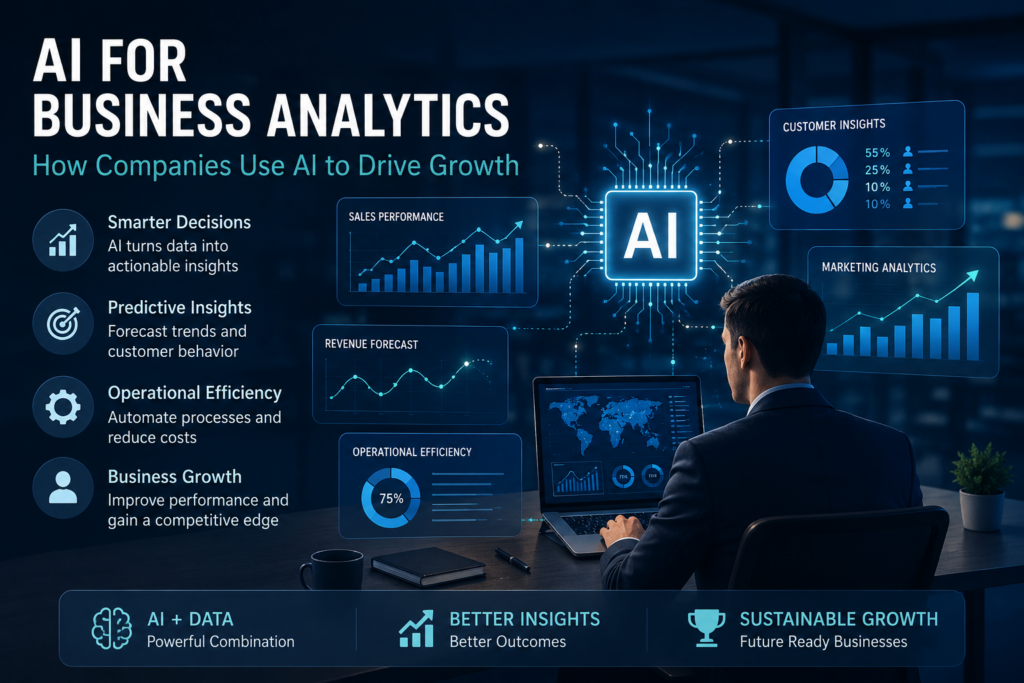
Best Ways Companies Use AI for Business Analytics
Companies across industries are adopting AI in different ways. Below are the most common applications:
1. Customer Behavior Analysis
AI tracks customer interactions and predicts future buying behavior. This helps businesses increase conversions and improve personalization.
2. Sales Forecasting
AI analyzes past sales data to predict future performance. This helps companies manage inventory and reduce waste.
3. Fraud Detection
Banks and fintech companies use AI to detect suspicious transactions instantly.
4. Marketing Optimization
AI tools analyze campaign performance and suggest improvements for better ROI.
5. Operational Efficiency
Manufacturing companies use AI to monitor equipment and prevent breakdowns.
As organizations scale their tech infrastructure, keeping pace with these technological implementations is essential for maintaining market relevance. To see how these technologies are shaping corporate strategies and data management on a broader scale, explore the definitive look at the latest business intelligence trends in the US.
Benefits of AI for Business Analytics
There are several key benefits of using AI for business analytics:
- Faster decision-making
- Improved accuracy in forecasting
- Reduced operational costs
- Better customer experience
- Real-time insights
In fact, studies show that companies using AI-driven analytics improve productivity by up to 30%.
Tahari Solution3 helps businesses achieve these benefits by offering advanced AI-powered analytics solutions tailored to different industries.
Real-World Examples of AI in Business Analytics
To understand the impact, here are a few examples:
- E-commerce: Amazon uses AI to recommend products based on browsing behavior.
- Healthcare: AI predicts patient risks and improves diagnosis accuracy.
- Banking: AI detects fraud patterns within milliseconds.
- Retail: AI optimizes pricing strategies based on demand.
These examples show how AI for business analytics is transforming industries globally.
AI vs Traditional Business Analytics
| Feature | Traditional Analytics | AI for Business Analytics |
|---|---|---|
| Speed | Slow | Real-time |
| Accuracy | Moderate | High |
| Insights | Limited | Predictive + Prescriptive |
| Automation | Low | High |
Clearly, AI is more advanced and scalable compared to traditional systems.
How Tahari Solutions Helps Businesses Grow
Tahari Solutions provides modern AI-powered tools designed to simplify business analytics. It helps companies turn raw data into actionable insights without needing complex technical skills.
With Tahari Solution3, businesses can:
- Automate reporting processes
- Predict customer behavior
- Improve marketing performance
- Optimize operations
- Make data-driven decisions faster
This makes AI for business analytics more accessible even for small and medium-sized businesses.
What Are the Best Ways to Implement AI in Analytics?
Here are the best strategies:
- Start with clean and structured data
- Use scalable AI platforms like Tahari Solution3
- Focus on specific business goals first
- Train teams on AI tools
- Continuously monitor performance
By following these steps, companies can maximize the impact of AI for business analytics.
FAQs About AI for Business Analytics
1. What is AI for business analytics used for?
It is used to analyze data, predict trends, and support decision-making in businesses.
2. How does AI improve analytics accuracy?
AI learns from historical data and reduces human errors, making insights more accurate.
3. Is AI for business analytics expensive?
Not necessarily. Solutions like Tahari Solution3 offer scalable pricing for businesses of all sizes.
4. Can small businesses use AI analytics?
Yes, small businesses can benefit from AI tools to improve marketing, sales, and operations.
5. What industries benefit most from AI analytics?
Retail, healthcare, finance, logistics, and e-commerce benefit the most.
Final Thoughts
The adoption of AI for business analytics is no longer optional—it is essential for competitive growth. Companies that leverage AI gain faster insights, better predictions, and improved efficiency.
With solutions like Tahari Solutions, businesses can easily transition into AI-driven decision-making and stay ahead in a data-driven world.
If your business is ready to grow, now is the time to embrace AI-powered analytics.



1 Comment
Share your thoughts and join the conversation
Leave a Comment